
Ever check the forecast, head out, and still feel colder than the number said? That’s because the forecast’s actual temperature and the feels-like your body senses differ. Dress for the feels-like, not the raw number. Here’s how to adjust.
1. Dress for the “feels-like”
The reported air temperature assumes no wind and no direct sun. Your body, though, reacts to wind, humidity and sunlight. So don’t take the forecast at face value — nudge it a few degrees for today’s conditions and dress for that.
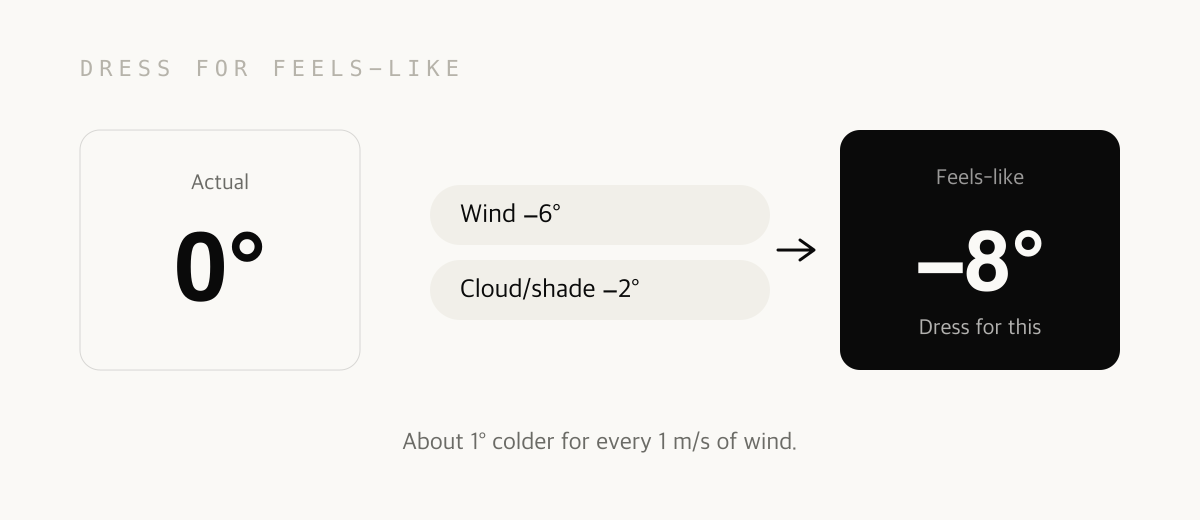
2. Wind is the biggest factor
In the cold, wind lowers the feels-like the most: roughly 1°C colder for every 1 m/s of wind. Above 4 m/s, treat it as 3–6°C below the actual temp and add a windproof layer. If it’s an actual 5°C but windy, look at 0°C outfits.
3. Humidity and sunlight
- Summer humidity — sweat can’t evaporate, so it feels hotter than the number. Go breathable, skip heavy layers.
- Cloud, shade, night — without sun it feels 1–3°C cooler. Bump one step warmer.
- Bright midday sun — even in winter, strong sun raises the feels-like. You can go one step lighter.
4. A practical adjustment table
| Today's condition | Feels-like shift | How to dress |
|---|---|---|
| Strong wind (4 m/s+) | −3 to 6° | Use a colder temp page + windproof outer |
| Cloud / shade / night | −1 to 3° | One step warmer |
| Bright midday sun | +1 to 3° | One step lighter |
| High summer humidity | Feels hotter | Breathable, minimal layers |
5. Common mistakes
- 1Only reading the number — a windy day is much colder at the same temp. Check wind speed too.
- 2Ignoring summer humidity — the same 30°C is far hotter when humid. Breathability wins.
- 3Skipping wind protection — blocking wind often beats sheer thickness for winter feels-like.
If it’s windy, treat it as a few degrees colder and check 5°C and 0°C outfits; in a heatwave, see the heatwave guide.